
Access Control & Door Entry for Saskatoon Businesses
Give every person their own credential, see who went where, and revoke someone in seconds instead of changing every lock in the building. KeenAI installs door access and entry systems for Saskatoon businesses, buildings and sites.
- Locally owned, Saskatoon
- Per-person credentials
- Fails safe, and to code
Keys do not tell you anythingAnd they never come all the way back
A key says nothing about who used it, or when. It cannot be switched off. When someone leaves — a member of staff, a cleaner, a contractor, a tenant — you are trusting that every copy came back, and copies are cheap. That is why the honest answer to “has anyone still got a key?” in most buildings is: probably.
Access control replaces that guess with a record. Each person carries their own credential, every door knows who opened it, and taking someone’s access away is a change on a screen rather than a locksmith’s invoice and a fresh set of keys for everyone else.
What we install
Readers, fobs and phone entry
Card and fob readers at the doors that need them, with phone-based unlocking where it suits the people using it. One credential per person, not one key per building.
Electric strikes, maglocks and door hardware
The right release for the door and its frame, wired with request-to-exit and door-position monitoring so the system knows whether a door actually closed — not just whether it was unlocked.
Schedules and door groups
Front door unlocked during trading hours and locked automatically after. Cleaners with evening access to the areas they clean and nothing else. Contractors with access that expires on its own.
Audit trail
A record of which credential opened which door and when. It settles the questions that otherwise turn into arguments, and it is the thing keys can never give you.
Intercom and multi-unit entry
Door stations for apartment blocks and offices, so residents and staff can see and speak to whoever is at the entrance before letting them in.
One system with your cameras
Access events and camera footage on the same platform, so an entry at 02:14 has a picture attached to it rather than needing two systems and a manual timestamp hunt.
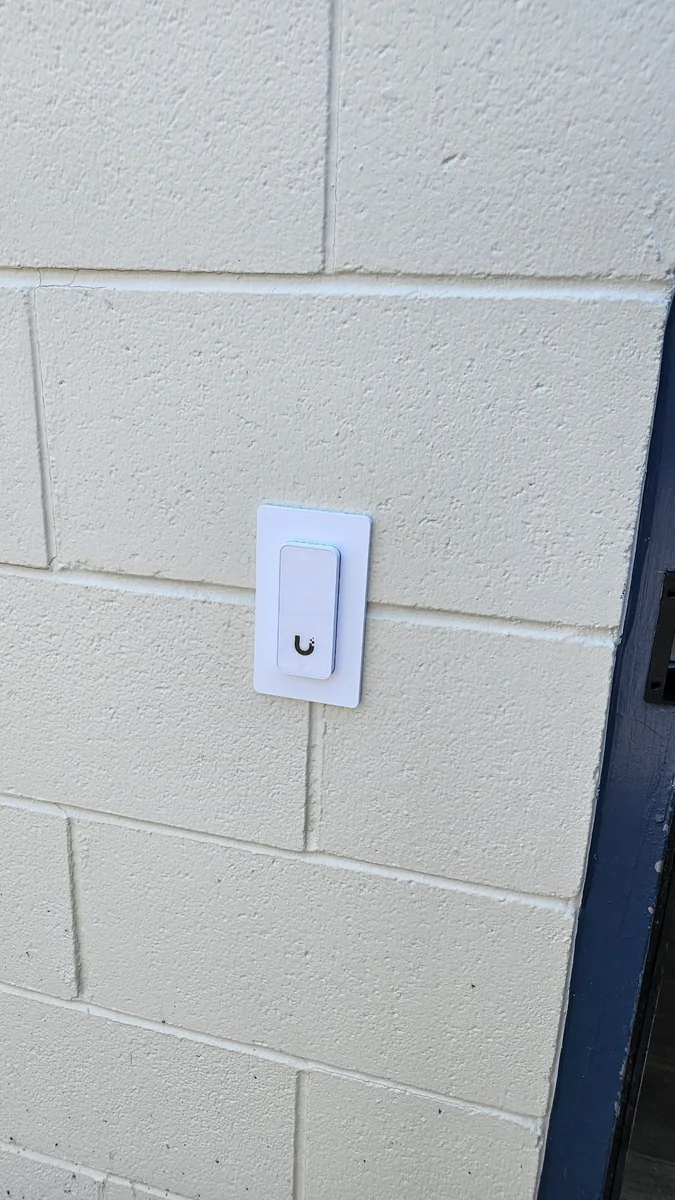
A reader on the door people actually use
An entry reader mounted on the exterior wall alongside the door. Most of the work on an access job is not the reader — it is the cabling, the release hardware in the frame, and making sure the door behaves correctly when power or network goes away.
The part most quotes leave outWhat happens when things go wrong
- Power failure. Every door has to be specified as fail-safe or fail-secure deliberately, and life-safety egress must work regardless. This is a code matter, not a preference, and it gets decided at the survey.
- Network failure. Controllers keep enforcing their existing permissions when the network drops. People do not get locked out of the building because a switch failed.
- Doors that are propped or left ajar. Door-position monitoring is what turns “the door was unlocked at 6pm” into “the door stood open for forty minutes”.
- Leavers. A system nobody maintains drifts back into the same problem keys had. We set it up so removing somebody takes seconds, and we show you how.
The equipment we work with
We build primarily on Ubiquiti access hardware, and integrate with Hikvision where the site’s cameras or entry stations call for it. Both keep their controllers and records on your own equipment, so day-to-day access does not depend on somebody else’s cloud staying up or staying free.
Electrical work is carried out to code by licensed contractor partners, and we will always tell you which parts of a job are ours and which need another trade.
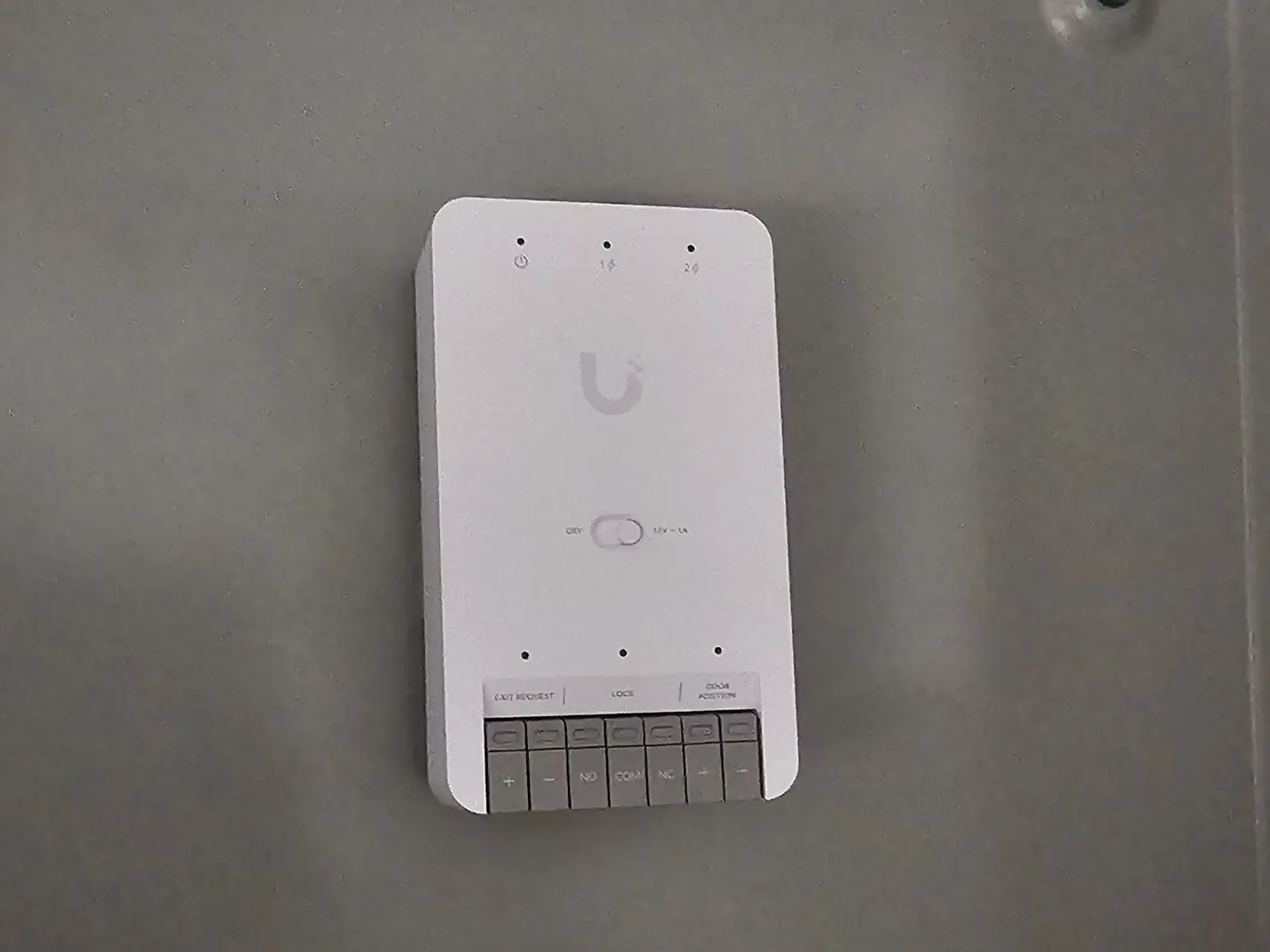
Behind the door, where the work really is
A door hub in its enclosure with exit request, lock and door-position conductors landed on labelled terminals. This is the part nobody sees and every future service call depends on — which is exactly why it gets done neatly and documented.
How a job runs
Free site assessment
We walk every door you are considering, check the frame and hardware, look at egress and code requirements, and find the cable routes. You get a door-by-door plan.
Fixed quote
Priced per door against that plan, so you can stage the work — the main entrance and the server room now, the rest later — without paying twice.
Installation
Readers, releases and controllers fitted and wired, with electrical work by licensed partners where required. Doors tested for both normal operation and power-loss behaviour.
Handover and training
People and credentials loaded, schedules set, and your administrator shown how to add a person, revoke one, and pull the audit trail before we leave.
Who we do this for
Offices, warehouses and yards, retail and hospitality, multi-unit residential buildings, and any site where staff, tenants or contractors change often enough that keys have stopped making sense. Behind KeenAI are 22 years of IT-infrastructure and smart-systems experience and 130+ projects delivered.
Serving Saskatoon, Regina and across Saskatchewan
KeenAI is locally owned in Saskatoon and works throughout the surrounding communities including Warman and Martensville. For commercial projects we travel — Regina and other Saskatchewan centres are within our normal working area, and we will consider work further afield in Alberta where the project justifies it. Ask before you spend anything and we will give you a straight answer about travel.
Frequently asked questions
What does an access control system actually do?
It replaces shared keys with individual credentials — a fob, card or phone — and records which credential opened which door and when. Access can be granted, restricted to certain hours or doors, and revoked instantly without changing any locks. That combination of control and record is what a key cannot provide.
What happens to the doors in a power cut?
Each door is specified as fail-safe or fail-secure at design time, and egress must remain possible in every case — that is a code requirement rather than an option. Controllers are typically supported so the system rides through short outages, and we walk you through exactly how each door will behave before anything is ordered.
Do I have to do the whole building at once?
No, and most sites should not. The usual approach is to start with the doors that carry the most risk — the main entrance, the server or stock room, the yard gate — on a design that lets the remaining doors be added later without replacing what is already installed.
Can access control work with our existing cameras?
Often, yes. Where the platforms fit together, an access event and the corresponding footage sit side by side, so an out-of-hours entry comes with a picture attached. Where they do not, we say so at the assessment rather than promising integration that turns out not to exist.
Can we use phones instead of fobs?
Yes. Phone-based credentials suit staff who already carry a phone everywhere and remove the cost of replacing lost fobs. Physical fobs remain the better answer for visitors, contractors and anyone who would rather not install an app, and most sites end up running both.
Is there a monthly fee?
Not to run the doors. Controllers and records live on your own equipment, so opening doors and reviewing the audit trail costs nothing per month. Any optional service that does carry a fee is identified before you buy, not after.
Find out how many keys are still out there
A free site assessment gives you a door-by-door plan and a fixed price — and an honest view of which doors genuinely need a reader and which do not.
Commercial security cameras · Networking and structured cabling · Home security and smart locks