
Commercial HVAC Controls & Indoor Air Quality in Saskatoon & Regina
Half the floor is too hot, the other half wears coats, and the boardroom goes stuffy by ten. We measure the building first — temperature, CO₂ and humidity, zone by zone — then put heating, cooling and ventilation on schedules and controls that follow how the building is actually used.
- Measured before changed
- Works with your existing plant
- Saskatoon & Regina
What do smart HVAC controls do for a commercial building?
They replace guesswork with measurement. Sensors in the zones people actually use log temperature, CO₂ and humidity; controls then run the plant to real occupancy instead of a fixed timetable, bring in fresh air when a room fills, and alert a person before a fault becomes a cold building on Monday morning.
Thermostat wars are a measurement problem, not a personality problem. One sensor by the door is deciding the temperature for a floor with six different solar exposures, and the air handler is running a schedule set by whoever commissioned it years ago. Nobody has ever measured the place — so nobody can fix it.
- Measured, zone by zoneTemperature, CO₂ and humidity where people work, logged over time.
- Air that follows the roomVentilation driven by CO₂ where the plant allows it.
- Schedules that match realityHolidays, shifts and empty floors, not a factory timetable.
- Alarms that reach a personFreeze risk and plant failure, routed to whoever is on call.
What the system does between 6 a.m. and 3 a.m.
Warm-up starts
The plant comes off setback early enough that the first person in finds the floor at temperature — not a minute earlier than it needs to.
The boardroom fills
Twelve people and a closed door push CO₂ past 1,000 ppm. Fresh air opens up for that zone instead of the whole building.
The sun moves west
The east offices cool off and the west side heats up. Each zone is read on its own, so each is treated on its own.
The building empties
Setback follows the real schedule — including the statutory holiday nobody remembered to programme.
Something goes wrong
A unit stops heating on the coldest night of the month. The on-call person is told now, not when the pipes have already frozen.
Comfort and air, measured and on one screen
We’re bringing a building version of KeenAi One — the same core that already runs climate in our homes, with a view made for facility teams. Every zone’s real reading beside its setpoint, the rooms where air is falling behind, and the schedule that drives it.
- Measured beside set: the zone that says 21.5° and reads 24.6° stands out.
- CO₂ through the day, so “the boardroom is stuffy” becomes a chart and a fix.
- Schedules with holidays loaded, changeable by your team without a service call.

Measurement first, then control
Zone monitoring
Temperature and humidity sensors in the zones people actually complain about, logged over time, so a comfort argument becomes a chart instead of an opinion.
Air-quality sensing
CO₂, fine particles and VOCs measured continuously in meeting rooms, classrooms, gyms and open floors — where occupancy swings hardest.
Scheduling & setback
Heating and cooling that follow how the building is occupied, including holidays, shift patterns and the weeks a space sits empty.
Demand-based ventilation
Where the plant allows it, fresh air driven by measured CO₂ rather than running flat out all day: better air when the room is full, less waste when it isn’t.
Alerts that reach a person
Freeze risk, plant failure and out-of-range rooms sent to whoever is on call — because the expensive HVAC failure is the one on a long weekend.
Several buildings, one view
Multiple sites with per-person logins, so a facilities manager isn’t signing into four systems to answer one question.
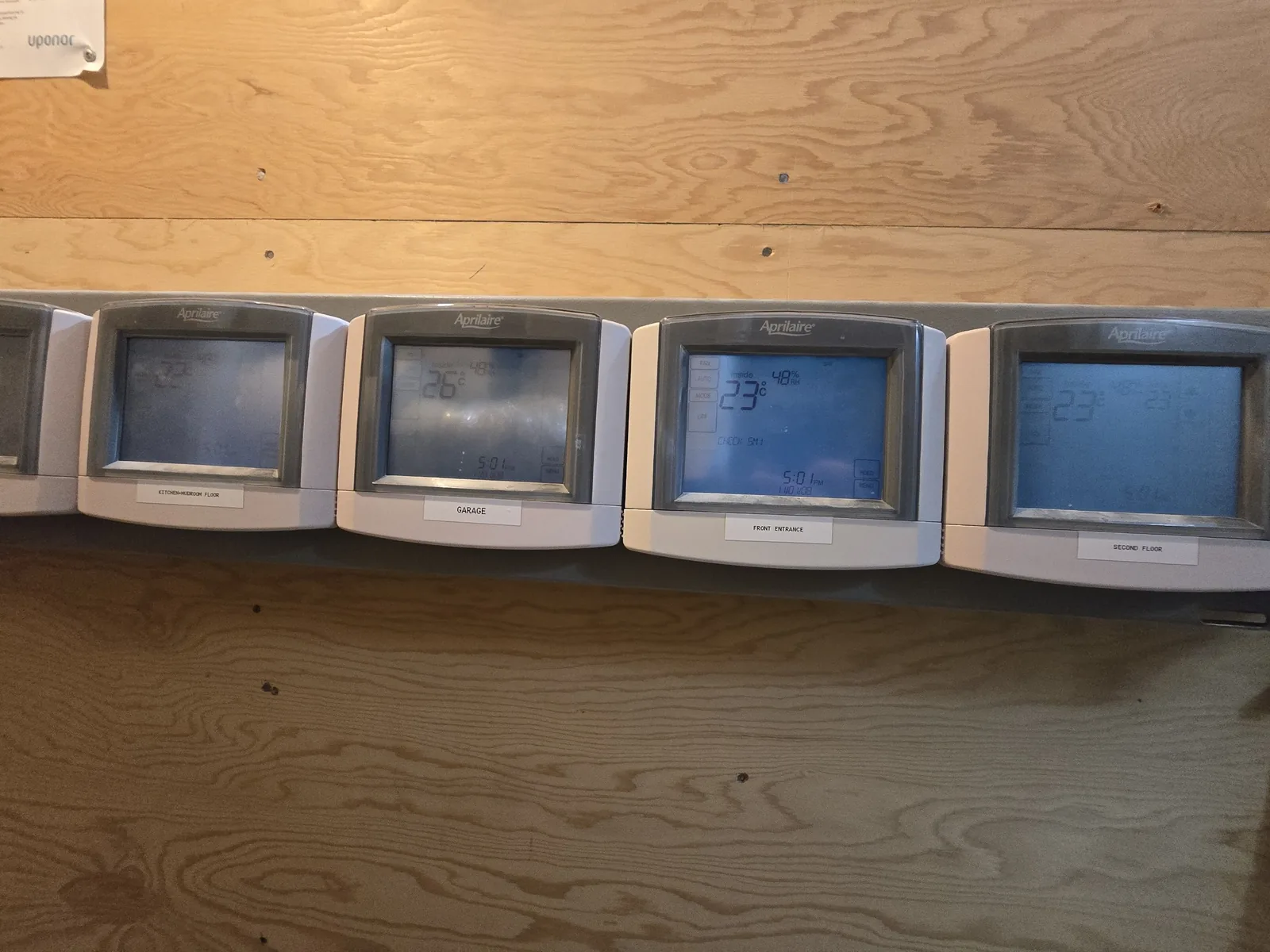
A thermostat per zone, an opinion per thermostat
A row of zone thermostats, each deciding on its own from one sensor on one wall. Every one of them works. None of them knows what the others are doing, and nobody can see the building as a whole.
- Bring them into one view where they can be integrated, and say plainly where they can’t.
- Add a real reading where people sit, not just where the thermostat happens to be.
- Keep what works. Replacing working controls is rarely what fixes the complaint.
What we won’t tell you, because we can’t know it yet
- A percentage you’ll save. Anyone quoting an energy saving before measuring your building is guessing. It depends on your plant, your envelope, your occupancy and your winter.
- That controls fix everything. We’ll be specific about what controls can fix and what needs mechanical work by a licensed HVAC contractor.
- That you need new equipment. Sometimes the honest answer is that your money belongs in balancing or a damper repair, not in anything we sell.
What we will do is measure first, show you what the building is actually doing, and prioritise by what the numbers show.
Open controls, not a dealer lock
We build on open, widely supported controls rather than a proprietary system that ties the building to one dealer. The platform we build on supports more than 1,500 device integrations, so existing thermostats, rooftop units, sensors and meters can usually be brought into one view rather than replaced.
Thermostats & zone control
Including line-voltage heat in apartments and offices
- Sinopé
- Honeywell
Existing building controls
Systems we connect to and build around
- Siemens
- Johnson Controls
- Schneider Electric
- Honeywell
Open protocols
How plant equipment usually reports in
- BACnet
- Modbus
Highlighted: KeenAI is a Sinopé Authorized Reseller & Installer. Other brand names are trademarks of their owners, listed for compatibility; this is not a claim of dealer or partner status. What can be integrated is confirmed per building at the assessment.
Buildings where people notice the air
Offices & clinics
Meeting rooms that go stuffy, corner offices that bake, and waiting rooms that need to stay comfortable all day.
Schools & community
Classrooms, gyms and halls where occupancy swings hardest and CO₂ follows.
Retail & warehouses
Occupied office space beside big open volumes, on schedules that change with the season.
Property managers
Several sites, one view, and freeze alerts on the buildings nobody visits daily.
Measure, review, then automate
Free building assessment
We walk the building with whoever fields the complaints, look at the plant and existing controls, and pick the zones worth instrumenting first.
Measure before changing anything
Sensors log long enough to see the pattern — a full week at minimum, through a weekend, because the empty building tells you as much as the full one.
Review the data together
You see what the building actually does. Fixes are prioritised by the measurements, not by what is easiest to sell.
Automate & hand over
Schedules, setbacks and alerts set against real occupancy, and your team shown how to read the dashboard and change a schedule without calling us.
Commercial HVAC & indoor air quality: frequently asked questions
What is a good CO₂ level for an office or classroom?
Outdoor air sits around 400 ppm, and indoor readings are commonly read against that baseline: values close to outdoor suggest generous ventilation, while readings climbing well above roughly 1,000 ppm indicate a space where ventilation isn’t keeping pace with the number of people in it. Measuring shows when and where your building crosses that line — almost always a specific room at a specific time, not the whole building all day.
Can smart HVAC controls work with the equipment we already have?
Usually. Most commercial plant can be monitored and scheduled without replacement, and the platform we build on supports more than 1,500 device integrations, so existing thermostats, rooftop units, sensors and meters are typically brought into one view. Equipment that genuinely can’t be integrated is identified at the assessment, before anything is ordered.
How much will this save on our energy bill?
We won’t put a number on that before measuring your building, and any figure quoted before a site visit is a sales device, not an estimate. Savings depend on your plant, envelope, occupancy and winter. Measurement comes first; the honest projection comes after.
Do you do the mechanical HVAC work?
No. We install the sensing, controls, scheduling and alerting. Mechanical work — equipment replacement, refrigeration, ductwork, balancing and repairs — is done by licensed HVAC contractors, and we work alongside yours or recommend one.
What is demand-controlled ventilation?
Ventilation that responds to how many people are actually in a space, usually by measuring CO₂. When a room fills, more fresh air comes in; when it empties, the system stops heating outdoor air nobody is breathing. Whether your plant can do it depends on its dampers and controls, which we check at the assessment.
Do you replace our building management system?
Not usually. Where a BMS exists and works, the useful project is normally adding measurement, alerting and a clearer view around it. See our building management systems page for when a broader system makes sense.
What about air quality in a building sealed for winter?
This is where measurement earns its place. A building tightened against a prairie winter trades heat loss for air exchange, so CO₂ and humidity behave very differently in January than in June. Both are straightforward to manage once you can see them, and guesswork until you can.
How long do you measure before recommending anything?
A full week at minimum, and always through a weekend. Occupied and empty periods both matter: the empty building shows what the plant does when nobody is there to complain.
What happens if the internet goes down?
Control and scheduling run on equipment inside the building, so the plant keeps to its schedule when the connection drops. Remote access and off-site alerts pause and resume on their own when it returns.
Can you monitor several buildings at once?
Yes. Multiple sites sit in one view with individual logins, so access can be granted and revoked as staff change, and a facilities manager answers a question in one place rather than four.
What is KeenAi One for buildings?
A building version of our KeenAi One platform, in development: the same core that runs climate, lighting and water in our homes, with a view made for facility teams. Each system keeps its own controls underneath, so nothing depends on the screen.
Updated October 2026.
Comfort is one part of the building
Stop arguing about the thermostat. Measure the building.
A free assessment tells you which zones are worth instrumenting and what a first phase involves — with no savings percentage invented before anyone has looked at your plant.
Saskatoon, Warman, Martensville, Regina and across Saskatchewan.