
Building Management Systems in Saskatoon & Regina
Most buildings already have the equipment. What they lack is one place to see it, one place to control it, and someone who answers when it stops behaving. We design, install and document building management on open standards you own — heating and ventilation, lighting, water, doors and cameras in one view.
- Open standards, no lock-in
- Documented handover
- Saskatoon & Regina
What is a building management system?
A building management system — a BMS, or building automation system — is the central platform that monitors and controls a building’s services: heating, ventilation and cooling, plus lighting, metering, water and often doors and cameras. It brings equipment installed separately into one view, runs it to a schedule, logs what it does and raises an alarm when something goes out of range.
It isn’t a new machine. It’s the layer that lets the machines you already own report in, run to how the building is actually used, and raise their hand before a failure becomes a callout.
- One view, not four loginsPlant, lighting, water, doors and cameras together.
- Runs inside the buildingSchedules and alarms keep working when the internet doesn’t.
- Open, and yoursNo dealer holding the keys to your own plant.
- Handed over properlyAs-built documents, logins and training that survive staff turnover.
Your building is already talking. Nobody is listening.
The rooftop unit knows it’s short-cycling. The boiler knows it fired eleven times last night. The clinic fridge knows it drifted two degrees at 3 a.m. on Sunday. None of them can tell anyone, so the first person to find out is a tenant, a caretaker or an insurance adjuster.
A building nobody is watching
- Each trade’s system on its own screen, if it has one at all.
- Plant on the factory schedule it was commissioned with.
- Faults found by the people they affect.
- “It’s always cold in here” with no data to settle it.
A building that reports in
- Every system in one view, with the same logins.
- Schedules that follow real occupancy and holidays.
- Alarms routed to whoever is on call, then escalated.
- Trend history, so a complaint becomes a chart and a decision.
The plant, the alarms and the meter on one screen
We’re bringing a building version of KeenAi One — the same core that runs our homes, with a view made for facility teams and property managers, beside water, entry, cameras and the network.
- Every piece of plant reporting in, with the one that’s misbehaving at the top.
- Alarms with a trail: what happened, who was told, and when it came back in range.
- The main meter through the day, so the overnight load is visible, not a surprise on the bill.
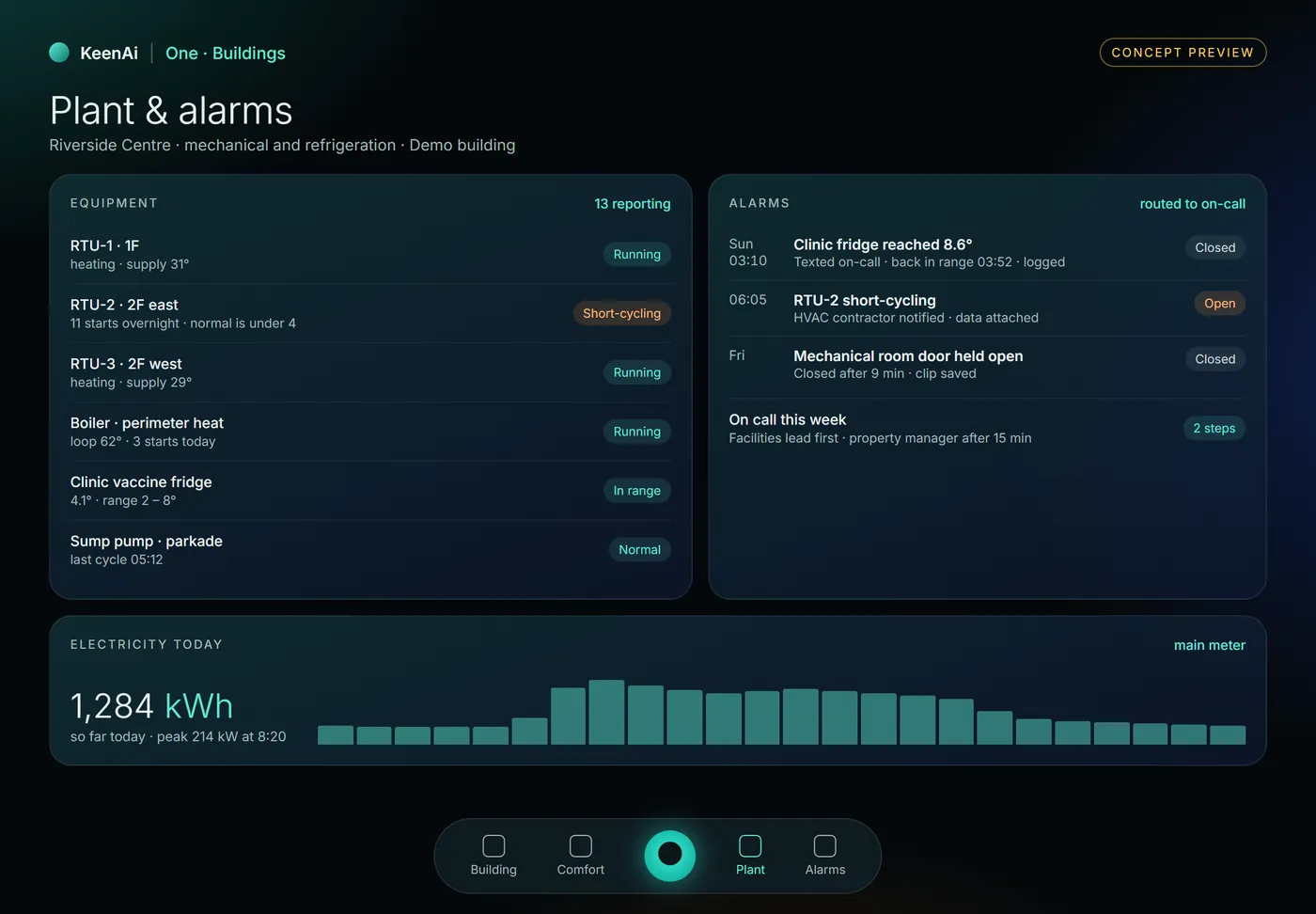
One system for the building’s services
One dashboard for the building
Heating, cooling, ventilation, lighting, water, doors and cameras in a single view instead of four systems, four logins and four support numbers.
Schedules that match occupancy
Plant that runs when the building is used and steps back when it isn’t, including holidays, shift patterns and floors that sit empty half the week.
Alarms that reach a human
Freeze risk, plant failure, a door left open, a fridge out of range — routed to whoever is on call, not to an unread inbox.
Trend data you can argue with
Logged history, so “it’s always cold in here” becomes a chart and a decision instead of a standing complaint.
Integration with what you own
Thermostats, rooftop units, meters, sensors and controllers brought in where they can be, and identified honestly where they can’t.
Several buildings, one view
Multi-site portfolios with per-person logins, so a facilities manager answers a question in one place instead of four.
Why buildings end up with four systems instead of one
Each trade brought its own
The HVAC contractor installed one platform, the security company another, the lighting supplier a third. Every one works. None of them talk.
The dealer holds the keys
Proprietary systems tie the building to one company for the life of the equipment. When that relationship ends, so does practical control of your own plant.
Nobody was trained
The system was commissioned, handed to somebody who has since left, and has run on its factory schedule ever since.
The documents are lost
A folder nobody can find is the same as no documentation on the day something fails.
AI that explains the building, rules that run it
We’re bringing AI into KeenAi One for buildings as an analyst, not an operator: it reads what the building did and tells you in plain words. It doesn’t get its hands on the plant.
- What happened overnight, in a paragraph, instead of a page of alarm codes.
- Patterns worth a look: a unit starting more often than usual, a zone that never reaches setpoint, a load that never switches off.
- A draft for the contractor, with the trend data attached, for a person to check and send.
- No AI in the control path. Heating, doors, water and anything safety-critical run on fixed rules and people’s decisions, and the building runs fully with AI switched off.
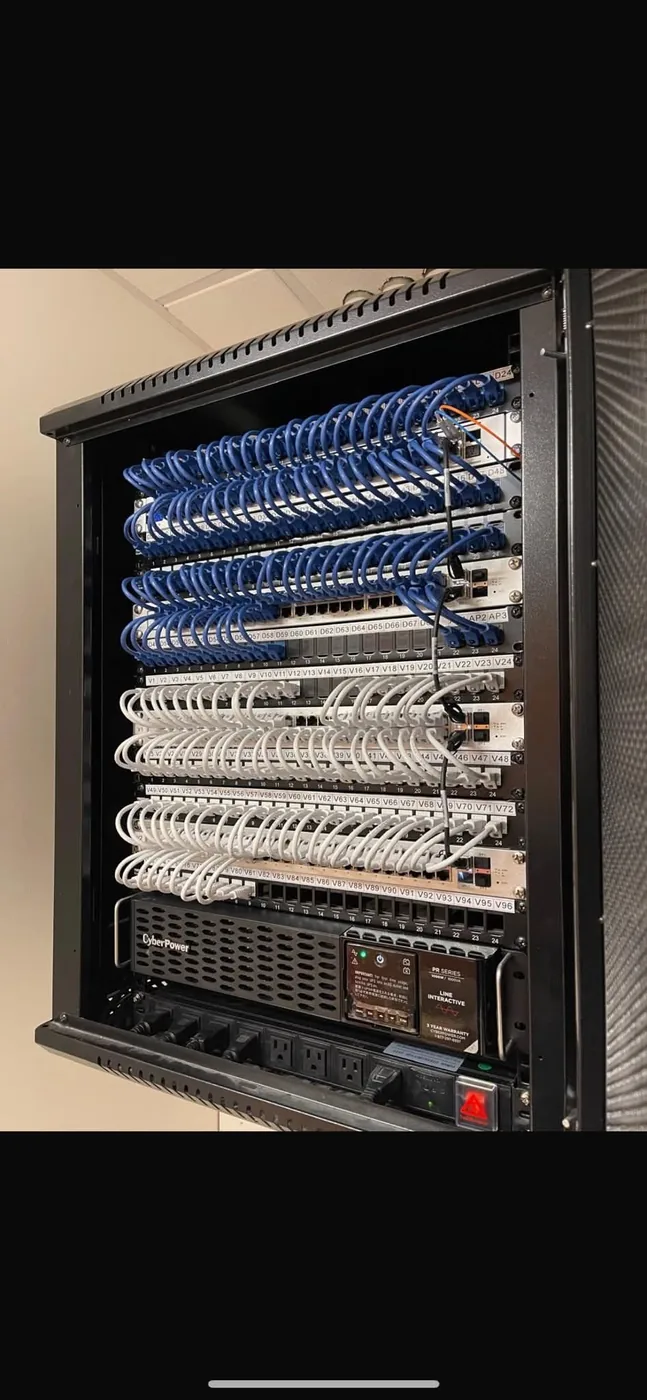
Numbered, terminated, documented
A building management system is only as reliable as what it runs on. That’s why we do the infrastructure and the controls, rather than layering software over cabling nobody documented.
- Ninety-six ports labelled and dressed, on protected power.
- The difference between a fault found in ten minutes and a fault found by tracing cable through a ceiling on a Saturday.
- Measured first, and we say so. We separate what controls can fix from what needs an HVAC or electrical contractor — and we don’t open with a savings percentage.
Open, and able to talk to what you already own
We build on open, widely supported controls rather than a proprietary system that ties you to one dealer. The platform we build on supports more than 1,500 device integrations, so existing equipment can usually be brought into one view rather than replaced. Where a building already runs a manufacturer’s BMS and it works, we’ll say so.
Existing building controls
Systems we connect to and build around
- Siemens
- Johnson Controls
- Schneider Electric
- Honeywell
Open protocols
How plant and lighting report in
- BACnet
- Modbus
- DALI
Entry & cameras
On the same design
- Ubiquiti UniFi
- Hikvision
Water & heat
Suites and line-voltage heat
- Sinopé
Highlighted: KeenAI is a Sinopé Authorized Reseller & Installer, and Ubiquiti UniFi and Hikvision are the camera and entry platforms we build on. Other brand names are trademarks of their owners, listed for compatibility; this is not a claim of dealer or partner status. What can be integrated is confirmed per building at the assessment.
Staged, so you can prove it before you extend it
Free building assessment
We walk the building with whoever fields the complaints, look at the plant, the existing controls and the network, and establish what can be integrated and what can’t.
Measure before changing anything
Sensors log long enough to see the pattern — a full week at minimum, through a weekend.
A staged plan & written quote
A fixed scope you can approve as a first phase, prove, and extend without re-engineering what’s installed.
Handover that survives turnover
As-built documentation, per-person logins, and your team shown how to change a schedule, acknowledge an alarm and read a trend.
Building management systems: frequently asked questions
What does a building management system control?
Typically heating, ventilation and cooling, plus lighting, metering and water, and often doors and cameras. It monitors each, runs them to schedules, logs what they do and raises alarms when something goes out of range.
What is the difference between a BMS and a BAS?
In practice the terms are used interchangeably. “Building automation system” leans toward automatic control of plant; “building management system” leans toward the monitoring, scheduling and reporting layer on top. Both describe one system that runs and reports on the building’s services.
Can a BMS work with equipment we already have?
Usually. Most commercial plant can be monitored and scheduled without being replaced, and the platform we build on supports more than 1,500 device integrations. Equipment that genuinely can’t be integrated is identified at the assessment, before anything is ordered.
Do we have to replace our existing BMS?
Not usually. Where a building already runs a manufacturer’s system and it works, the useful project is normally adding measurement, alerting and a clearer view around it. Replacing working plant controls is expensive and rarely fixes the complaint that prompted the call.
How much will a building management system save on energy?
We won’t put a figure on that before measuring your building, and any percentage quoted before a site visit should be treated as a sales device rather than an estimate. Measurement comes first and the honest projection comes after.
What happens if the internet goes down?
Control and scheduling run on equipment inside the building, so plant keeps operating to its schedule when the connection drops. Remote access and notifications pause and resume on their own when the link returns.
Who owns the system, and can someone else service it?
You do. Systems are built on open standards, you own the hardware, and the handover includes as-built documentation and administrator access, so another competent contractor can service what we install.
Can the BMS include doors, cameras and water?
Yes. That’s one of the main reasons to do it with us: access control, cameras, water protection and the network can be designed together, so an alarm in one shows up beside the others.
Does AI control our building?
No. In KeenAi One for buildings, which is in development, AI explains what the building did and suggests what to look at. Plant, doors, water and anything safety-critical run on fixed rules and people’s decisions, and the system runs fully with AI switched off.
Can alarms go to different people at different times?
Yes. Alarms can be routed by type and time of day — the facilities lead first, then a property manager if nobody acknowledges — and every alarm keeps a record of who was told and when it cleared.
Does KeenAI install building management systems in Regina?
Yes. KeenAI is based in Saskatoon and takes commercial work across Saskatchewan, including Regina, and will consider projects in Alberta where the job justifies the travel.
Updated October 2026.
The systems a BMS brings together
Find out what your building is already telling you
A free assessment establishes what can be integrated, what can’t, and what a first phase involves — with no savings percentage invented before anyone has looked at your plant.
Saskatoon, Warman, Martensville, Regina and across Saskatchewan.